
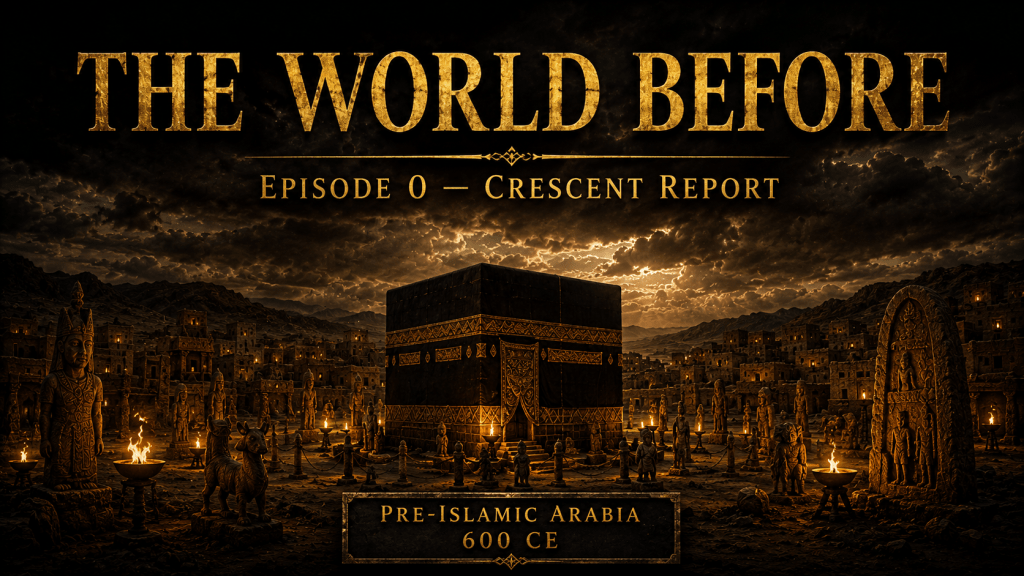
Episode 0 | Crescent Report
Before the Revelation. Before the Message. Before the transformation that would reshape the known world, there was Arabia.
To understand Islam, one must first understand the world into which it arrived. Not as a vacuum. Not as a desert of ignorance. But as a civilisational crossroads contested, complex, and charged with meaning.
This is Episode 0 of Crescent Report. The foundation before the story begins.
A World Divided by Four Powers
In the sixth century CE, the world was not defined by nations as we understand them today. It was defined by civilisations. Four of them dominated the horizon:
The Byzantine Empire the eastern successor to Rome, Christian in faith, Greek in culture, controlling the lands of present-day Turkey, the Levant, and Egypt.
The Sassanid Persian Empire the ancient rival of Byzantium, Zoroastrian in its imperial identity, stretching from Mesopotamia to Central Asia.
The Aksumite Empire the Christian kingdom of present-day Ethiopia and Eritrea, a naval power controlling the Red Sea trade routes.
Arabia not a unified empire, but a civilisational space of its own. Tribal. Ancient. Strategically positioned between all three powers, yet subject to none.
Arabia was not peripheral. It was central.
The Kaaba: Three Moments in History
At the heart of Arabia stood the Kaaba in Makkah. Its significance cannot be measured by the sixth century alone, it reaches back to the very beginning of human history on earth.
Three restorations mark its place across time, each carrying a different weight of reference:
First Adam ﷺ: The Quran establishes that the original foundation of the Kaaba traces back to Adam ﷺ. This is the primordial beginning, the first house designated for the worship of the One God on earth.
Second Ibrahim ﷺ and Isma’il ﷺ: This is the most prominent restoration in the Quranic narrative. Allah directly commanded Ibrahim ﷺ to raise the foundations of the Kaaba together with his son Isma’il ﷺ as a house of pure Tawheed absolute monotheism, no partners, no false gods beside Allah. This is the central Quranic theme of the Kaaba’s history.
Third Muhammad ﷺ: At the Conquest of Makkah, the Kaaba was purified and restored to its original purpose. By that time it had been surrounded by 360 idols. Every one of them was removed. This third restoration is documented through authenticated hadith and historical sources.
Three moments. The first and second established through the Quran. The third through authenticated historical record. The Kaaba is not merely a building, it is a civilisational timeline.
The Three Eras of Prophetic History
To understand the arrival of the final Message, one must understand how prophethood unfolded across human history.
Era One Adam ﷺ onwards: From the beginning, every nation and every people received revelation. The specific laws and practices varied across time and place. But the common core was universal and unchanging believe in One God, associate no partners with Him, make no false gods beside Allah. This was the foundation given to all of humanity.
Era Two The Two Lineages of Ibrahim ﷺ: Ibrahim ﷺ is the pivotal figure from whom two distinct prophetic lineages emerge:
The first lineage runs through Isma’il ﷺ leading ultimately to Muhammad ﷺ, the final and seal of all Prophets, sent not to one nation but to all of mankind until Yawm al-Qiyamah.
The second lineage runs through Ishaq ﷺ the prophetic line of Bani Isra’il, through which came a succession of Prophets including Musa ﷺ, Dawud ﷺ, Sulayman ﷺ, and culminating in Isa ﷺ. According to the Islamic worldview, Isa ﷺ was the last Prophet of the Bani Isra’il line.
Era Three Muhammad ﷺ: The Restoration of Al-Amin
The third significant moment involving the Kaaba occurred approximately five years before the first Revelation, when Muhammad ﷺ was 35 years old.
A flood had damaged the walls of the Kaaba. The tribes of Makkah came together to rebuild it. But when the time came to replace the Hajar al-Aswad the Black Stone a fierce dispute broke out between the tribal leaders over who would carry the honour of placing it. Swords were drawn. War was imminent.
An elder of Makkah proposed a resolution: whoever enters through Bab Banu Shaybah first the following morning shall be the arbitrator for all.
The next morning, every tribal leader waited in anticipation. The first to enter was Muhammad ﷺ.
Upon seeing him, the leaders of Makkah including those who would later become his fiercest opponents declared with one voice:
“Hatha al-Amin, radina, hatha Muhammad” “This is the Trustworthy One. We are satisfied. This is Muhammad.”
Muhammad ﷺ called for a cloak to be brought and laid flat on the ground. He placed the Hajar al-Aswad at its centre with his own hands. Then he invited a leader from each tribe to take a corner of the cloak and lift it together. When it reached the correct height, he ﷺ placed the Black Stone into position himself giving every tribe their share of the honour, and preventing bloodshed through wisdom.
This was not a moment of Prophethood. The Revelation had not yet come. But it reveals something fundamental about the man chosen to carry it that his trustworthiness, his wisdom, and his character were already established and recognised across all of Arabia before a single verse descended.
Al-Amin the Trustworthy. This is who he ﷺ already was.
References:
- Musnad Ahmad ibn Hanbal Hadith 15504 (Musnad al-Makkiyyin)
- Sirah Ibn Hisham Vol. 1, pp. 192–197 (earliest and most authoritative biography)
- Al-Mustadrak ala al-Sahihayn Imam al-Hakim, Hadith 1694 (graded Sahih)
- Al-Sunan al-Kubra Imam al-Bayhaqi, Vol. 5, p. 172
- Al-Bidayah wal-Nihayah Ibn Kathir, Vol. 2 (Chapter on the rebuilding of the Kaaba)
- Al-Rahiq al-Makhtum (The Sealed Nectar) pp. 87–88 (internationally awarded contemporary Sirah)
Hanifiyyah: Restoration, Not Innovation
The Arabs of pre-Islamic Arabia were not entirely without knowledge. Many retained a memory of Ibrahim ﷺ. They called the way of pure monotheism Hanifiyyah. The linguistic roots connecting Salaam, Shalom, and Islam all converge on the same ancient concept wholeness, peace, and submission to the One.
By the sixth century CE the Kaaba had been surrounded by idols. The original had been obscured. But it had not been erased.
What the final Message brought was not something alien to human history. It was the completion and restoration of what had always been there the original covenant between the human being and the Creator.
A Note on Al-Injeel
Among the four civilisations surrounding Arabia, two Byzantium and Aksum identified as Christian. This makes one clarification necessary from the outset.
The Quran refers to the revelation received by Isa ﷺ as Al-Injeel. This is the precise word used. Crescent Report uses that word consistently and deliberately.
Al-Injeel is the revelation given directly to Isa ﷺ by Allah. It is not the same as the Gospels.
The Gospels are accounts written by others, after Isa ﷺ, in Greek not in Aramaic, the language he spoke. No original Aramaic text of the revelation received by Isa ﷺ has survived. What exists today are multiple manuscript traditions varying between Orthodox, Catholic, and Protestant communities each representing translations of translations, revised across centuries, debated across councils. Muslim scholars of comparative religion have consistently maintained this distinction and have never agreed to conflate Al-Injeel with the Gospels.
This is not a statement of hostility. It is an academic observation applied with the same standard of textual scrutiny that the Islamic scholarly tradition applies to its own sources through the science of hadith evaluating chain of transmission, narrator reliability, and textual consistency. If data is corrupted or deformed at any point in the chain, the conclusions drawn from that data cannot be guaranteed to be sound. That is not hatred. That is epistemology.
Crescent Report applies the same evidentiary standard to all sources, consistently, without fear or favour.
A Note on Justice Quran 2:62 and Surah Al-Ikhlas 112
Crescent Report operates on a principle of absolute justice. White is white. Black is black. Every civilisation Byzantine, Sassanid, Aksumite, Arabian will be credited accurately. No propaganda. No distortion. Evidence only.
This principle is not a compromise of Islamic values. It is a Quranic position.
Allah says in Surah Al-Baqarah, verse 62:
“Indeed, the believers, Jews, Christians, and Sabians whoever truly believes in Allah and the Last Day and does good will have their reward with their Lord. And there will be no fear for them, nor will they grieve.”
This verse speaks to the divine justice of Allah toward sincere believers of previous eras those who followed the guidance of their own Prophet faithfully in their own time. It is not a statement that all paths are equivalent today. The Quran is clear in Surah Aal-Imran 3:85 that after the sending of Muhammad ﷺ, the accepted path is Islam.
It is also necessary to be precise about what “believing in Allah” means in this context. The Quran defines this with absolute clarity in Surah Al-Ikhlas (112):
قُلْ هُوَ اللَّهُ أَحَدٌ Say: He is Allah, the One
اللَّهُ الصَّمَدُ Allah, the Eternal Refuge
لَمْ يَلِدْ وَلَمْ يُولَدْ He neither begets nor was born
وَلَمْ يَكُن لَّهُ كُفُوًا أَحَدٌ And there is none comparable to Him
Allah does not beget. Allah has no son. Allah has no partners. Allah is absolutely and completely One not one in three, not three in one. This is Tawheed. This is the belief that Quran 2:62 refers to when it says “whoever truly believes in Allah.”
The Quran addresses directly in Surah At-Tawbah 9:30 that certain communities among both the Jews and the Christians attributed son-ship to Allah. This is addressed not as a cultural observation but as a theological correction. Crescent Report notes this as historical fact, with no hostility toward any community.
Justice toward all. Evidence above all. That is the standard of Crescent Report.
Watch Episode 0
▶ The World Before Islam: Arabia at the Crossroads of History
Crescent Report: Islamic History, Civilisation & Geopolitics crescent-report.com
 Crescent Report
Leave a comment