
Episode 1 Companion Post | The Crescent Report
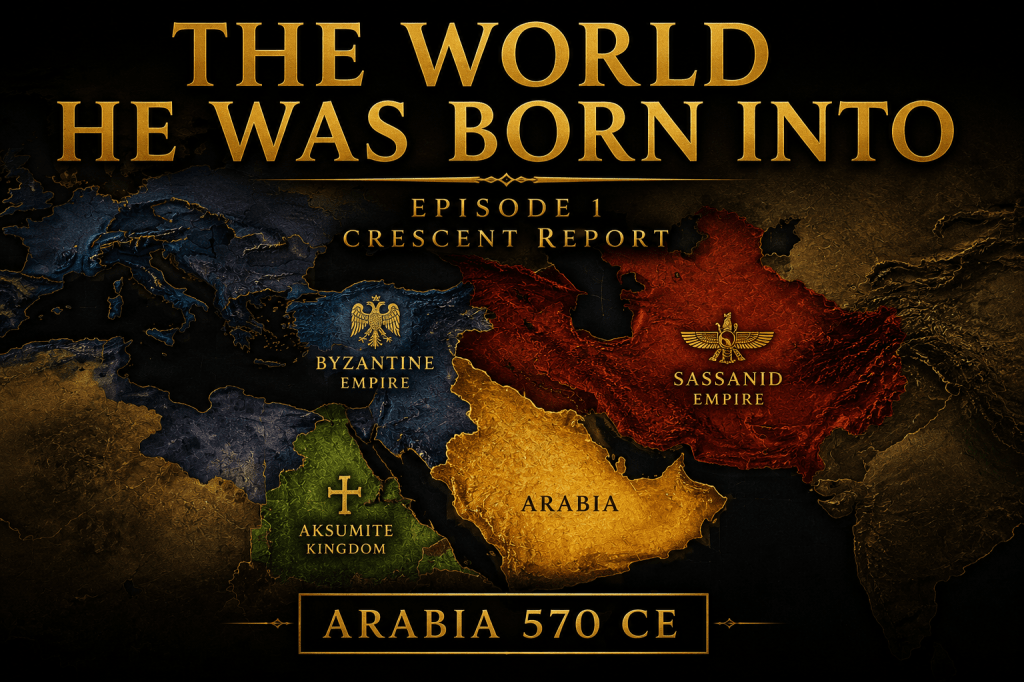
In 570 CE, the world was not at peace. It was exhausted. The two greatest empires on earth had been locked in a grinding conflict for so long that neither could envision what decisive victory would even look like. Between them, around them, and largely ignored by them, lay a peninsula that would shortly change everything.
This is the world Muhammad ﷺ was born into. And to understand what he brought to that world, you must first understand what that world looked like without it.
The Superpowers and Their Exhaustion
The Byzantine Empire in the sixth century was the last living heir of Rome. Christian, ancient, and administratively sophisticated, it controlled the eastern Mediterranean, North Africa, and parts of the Middle East. But decades of war with Persia had drained its treasury, fractured its frontier defences, and deepened its internal theological disputes. Ordinary people bore the cost of wars they had no say in starting and no hope of ending.
The theological disputes within Byzantine Christianity were not abstract academic debates. They were imposed on entire populations by imperial decree. The Council of Nicaea in 325 CE, convened by Emperor Constantine, did not represent a free gathering of scholars reaching consensus. It was a state-directed political meeting that determined which version of Christianity would become official imperial doctrine. Positions that had existed for centuries were declared heresy by imperial power, not by scholarly agreement. From that moment, Christianity in the Byzantine world functioned as a state instrument as much as a spiritual one, and the ordinary person had no voice in any of it.
The Sasanid Persian Empire was its mirror image. Zoroastrian, proud, and equally war-worn, Persia had been Rome’s great rival for centuries. By 570 CE the conflict had settled into a cold war fought not through direct confrontation alone but through proxy states and vassal kingdoms on the Arabian frontier.
The Ghassanids served Byzantium. The Lakhmids served Persia. Two Arab tribes, on their own ancestral land, fighting foreign wars for foreign masters.
Further south, the Kingdom of Axum in Ethiopia, a Christian ally of Byzantium, had extended its reach across the Red Sea into Yemen, controlling one of the most strategically valuable trade corridors in the ancient world.
Three empires. Three civilisations. All surrounding one peninsula that none of them fully controlled.
How Ordinary People Actually Lived
Geopolitical maps show borders and dynasties. They do not show the condition of the person who lived under them.
In Byzantine society, the overwhelming majority of the population were peasant farmers bound to land they did not own, paying taxes to an imperial administration they had no voice in, and receiving in return almost nothing by way of education, legal protection, or social mobility. Slavery was legal, widespread, and unremarkable. The strong took from the weak. Justice was administered by those with power over those without it.
Sasanid Persia maintained a rigid social hierarchy inherited from older Zoroastrian tradition. A person was born into a class and died in it. The priesthood, the warrior nobility, the scribes, and the commoners each occupied a fixed position in a system where birth determined destiny. Movement between classes was not a matter of merit. It was a matter of origin.
In Arabia itself, the tribal system provided internal solidarity but no universal protection. Outside your tribe, you had no rights. A traveller without tribal backing was vulnerable to robbery, enslavement, or death with no legal recourse whatsoever. Women had no inheritance rights. The poor had no institutional protection. Justice was tribal, personal, and negotiated through blood and vendetta.
In the lands of Al-Hind and Al-Sind, the region encompassing present-day Pakistan, India, Bangladesh, Nepal, Sri Lanka, the Maldives, and parts of Burma, known to Arab and Persian sources by those names and centred on the Indus Valley and Ganges-Yamuna civilisations, the caste system had calcified social structures in ways that made vertical mobility almost impossible for those born at the bottom. A person’s dignity, occupation, and legal standing were determined entirely by birth.
In the lands known to Arab sources as Al-Sin, governed in 570 CE by the Sui Dynasty, which would give way to the Tang Dynasty in 618 CE, Confucian principles emphasised hierarchical social order above individual rights. The region itself had no single name used by its own people, who identified by dynasty. The word China itself was not used by the people who lived there. It is a foreign rendering of the Qin dynasty name, transmitted through Persian as Chin and then adapted by other languages.
The pattern across all known civilisations was the same. Governance existed to serve those already in power. The strong took from the weak. Knowledge was the property of a priestly or scholarly class. The ordinary person, regardless of which empire or kingdom they were born under, had no mechanism to change their condition.
It is also worth acknowledging what was unknown. The Mesoamerican civilisations, including the Maya who were active and sophisticated in 570 CE, existed entirely outside the awareness of the connected world of Asia, Europe, and Africa. The further back we go in reconstructing those societies, the thinner the documentary record becomes, and the line between documented history and mythology becomes genuinely difficult to draw with precision. Crescent Report applies the same evidentiary standard to all civilisations: what can be verified, we state; what cannot, we acknowledge as uncertain.
This was not a coincidence of geography. It was the civilisational baseline of humanity in 570 CE. And it is the baseline against which what followed must be measured.
Arabia and the Force the Empires Underestimated
To the outside world Arabia was a footnote. No great empire had risen from its sands. No philosopher king had unified its tribes. No monument marked its centre.
They were wrong.
The people of the peninsula identified primarily by tribe and lineage, not by a single geographic label. The term Jazirat al-Arab, meaning the Island of the Arabs, appears in early Islamic sources as a geographic description of the peninsula. But in 570 CE the primary identity of any individual in that region was their tribe.
Ibn Khaldun, the fourteenth century Arab historian and father of sociology, identified the force that made this region far more formidable than it appeared. He called it Asabiyyah: group solidarity, the invisible bond that holds a people together through shared hardship, loyalty, and purpose. His argument was precise: no dynasty, no empire, no civilisation had ever risen without it.
Arabia had Asabiyyah in abundance. The very conditions that made it appear weak, the burning heat, the scarce water, the constant movement, had forged something the palace courts of Constantinople and Ctesiphon could not manufacture. A people who needed no city walls because they carried their strength within them.
Makkah and the Quraysh
At the centre of the peninsula sat a city unlike any other. Makkah was not powerful by the standards of the great empires. But it was uniquely positioned.
The Byzantine-Sasanid conflict had, without intending to, made Makkah the most important commercial corridor in the world. As war disrupted the Red Sea routes and the Tigris-Euphrates river routes, international caravans had no choice but to pass through the inland Arabian trade routes. Frankincense from Yemen, spices from India, silk from Al-Sin, gold from Africa. All of it passed through one city, governed by one tribe, the Quraysh.
The Quraysh were merchants and politicians. But they were also custodians of something far older than their commercial empire.
The Ka’bah and the Thread of Hanifiyyah
At the heart of Makkah stood a structure that even the polytheistic Arabs regarded with a reverence that transcended tribal divisions. A cubic stone house, ancient, simple, and powerful. The Ka’bah.
The Greek historian Diodorus Siculus had written about it centuries before Islam, describing it as exceedingly revered by all Arabians. Its origins, lost to most, went back further than any living Arab could trace.
The Quran identifies those origins clearly. Ibrahim ﷺ and his son Ismail ﷺ built and restored the Ka’bah, and Ibrahim ﷺ made a du’a asking Allah to raise from his descendants a messenger who would recite the revelations, purify the people, and teach them the Book and wisdom.
By 570 CE the Ka’bah’s courtyard held 360 idols. Polytheism had settled in over centuries. But a thread had survived, thin and almost invisible, yet unbroken. It was called Hanifiyyah: men and women who had never fully forgotten, who rejected the idols, who held, without a prophet, without a scripture, and without a community, to the belief in one God alone, the God of Ibrahim ﷺ.
The Quran clarified what this tradition represented. Ibrahim was neither a Jew nor a Christian. He was a Hanif, a Muslim, and he was not of the polytheists. The message that was coming was not something foreign. It was a restoration of the oldest truth humanity had ever been given.
The Year of the Elephant
570 CE is the year the peninsula would never forget, and not only because of a birth.
From Yemen marched the most powerful army the peninsula had ever seen. Abraha, the Ethiopian viceroy of Yemen, had built a magnificent cathedral in Sana’a and was determined to redirect the religious and commercial power of the region toward it. His army included something the Arabs had never faced: war elephants.
Makkah had no army, no walls, and no military alliance that could resist what was coming.
One man walked out to meet Abraha. Abd al-Muttalib ibn Hashim, chief of the Quraysh and custodian of the Ka’bah, a man whose lineage traced directly to the family that had built and maintained the house he now stood to defend. Abraha expected negotiation or surrender. Instead, Abd al-Muttalib asked only for the return of his camels.
Abraha was surprised. He said: you came to talk about camels while I am about to destroy your sacred house?
Abd al-Muttalib replied with words that have echoed through fourteen centuries: I am the lord of the camels. The house has its own Lord who will defend it.
He returned to Makkah, told his people to take refuge in the surrounding hills, and waited.
What followed was recorded in the Quran directly. Have you not seen what your Lord did to the people of the elephant? Did He not make their plan go wrong? And He sent against them flights of birds, pelting them with stones of baked clay, and He made them like eaten straw. Surah Al-Fil, 105:1 to 5.
Abraha’s army was destroyed before it reached the Ka’bah. The prestige of the Quraysh, guardians of a house that Allah Himself had defended, was elevated beyond anything military victory could have achieved.
The Birth of Muhammad ﷺ
In that same year, in that same city, in that same tribe whose honour had just been confirmed by divine intervention, a child was born.
Abd al-Muttalib took the newborn infant in his arms, walked to the Ka’bah, and presented his grandson to the Lord of the house. He named the child Muhammad, the praised one. It was a name never before given in the peninsula.
The du’a of Ibrahim ﷺ, made thousands of years earlier at the very foundation of that house, had just been answered.
The Lineage: Two Sons, Two Prophetic Lines
The birth of Muhammad ﷺ was not an isolated event. It was the culmination of a prophetic architecture established through Ibrahim ﷺ and his two sons.
From Ismail ﷺ came the Arab lineage, carrying the trust of Tawheed through generations until it reached the Hashimite family and then Muhammad ﷺ. From Ishaq ﷺ came the line of Bani Isra’il, the prophetic lineage that ran through Yaqub ﷺ, Yusuf ﷺ, Musa ﷺ, Dawud ﷺ, Sulayman ﷺ, and closed with Isa ﷺ, the final messenger sent specifically to the Bani Isra’il.
Between Isa ﷺ and Muhammad ﷺ lay the Fatrah, the period in which no prophet was sent anywhere in the world. 570 CE marked the end of that silence.
The Hashimite Shield
The protection surrounding Muhammad ﷺ in his early years was not accidental. It followed a pattern visible throughout prophetic history: Allah provides a shield for His messengers during their formation years.
Abd al-Muttalib, who had stood before Abraha’s army and entrusted the Ka’bah to its Lord, raised the young Muhammad ﷺ after the early deaths of his father Abdullah and then his mother Aminah. When Abd al-Muttalib himself passed, his son Abu Talib assumed guardianship and maintained it for decades, providing the tribal protection without which the early years of prophethood would have been far more difficult.
Formation: The Sunnah of the Prophets, Merchant, and Arbitrator
The years before prophethood were not idle. They were formative in ways that can only be understood in retrospect.
In his early years Muhammad ﷺ worked as a shepherd, completing what the prophetic tradition identifies as a Sunnah of the prophets. It was not his profession. It was a formation. Every prophet sent by Allah passed through this school. The work requires reading individual temperaments, patience with the stubborn and the frightened, responsibility for the vulnerable, and the ability to lead without force. Animals have their own characters and psychology, as anyone who has worked with them knows well, and managing a flock with wisdom translates directly into the qualities required of just leadership over people. Ibn Khaldun himself noted that practical formation in harsh conditions produced the kind of wisdom that palace education never could.
His profession was trade. He became a merchant of distinguished reputation, working on behalf of Khadijah RA, whose trust in his character preceded the revelation by years. His ultimate identity, confirmed by his own words and the mission itself, was Muallim: teacher.
He participated in the Fijar Wars as a young man, conflicts between tribes that violated the sacred months. The experience gave him direct knowledge of tribal warfare, its costs, and its futility.
He was present at the formation of Hilf al-Fudul, a remarkable pre-Islamic alliance in which several Makkan tribes agreed to collectively defend the rights of any oppressed person regardless of tribal affiliation. Muhammad ﷺ later said that even after Islam, he would not have abandoned the principles of that alliance. What Hilf al-Fudul represented was, in essence, a proto-framework for universal rights, assembled in a society that had no concept of universal rights, by a man who had not yet received a single verse of revelation.
And five years before the first revelation, when the rebuilding of the Ka’bah threatened to erupt into bloodshed over which tribe would have the honour of replacing the Black Stone, it was Muhammad ﷺ whose solution resolved the dispute without a single drop of blood. Every tribe lifted the stone together on a cloth, and he placed it in position with his own hands.
He was not yet a prophet. But the character of a prophet was already fully formed.
Jafar RA Before the Negus: What Islam Said It Was
When the early Muslims fled persecution in Makkah and sought refuge in Abyssinia, the Negus summoned them to his court to explain themselves. It was Jafar ibn Abi Talib RA who stood and spoke.
He did not begin with theology. He began with the condition of his people before Islam.
He said: O King, we were a people of ignorance. We worshipped idols, ate the flesh of dead animals, committed indecencies, broke ties of kinship, treated neighbours badly, and the strong among us devoured the weak. We lived like this until Allah sent to us a messenger from among ourselves, whose lineage, truthfulness, trustworthiness, and chastity we already knew. He called us to worship Allah alone, to abandon what we and our fathers used to worship in the way of stones and idols, and he commanded us to be truthful in speech, to fulfil trusts, to maintain ties of kinship, to be good to our neighbours, to refrain from what is forbidden, and to abstain from bloodshed.
That speech, delivered to a Christian king in Africa in approximately 615 CE, is one of the most precise descriptions ever given of what Islam represented as a social reform. It described the before and the after. It let the listener judge.
Why This Moment in History
It is worth pausing to ask why this particular moment, in this particular place, at this particular time.
By 570 CE, the world was more connected than it had ever been. Trade routes linked the peninsula to Al-Sin, Al-Hind, Africa, and the Mediterranean. Ideas, languages, and goods moved along those routes. A message that emerged from the centre of that network could, for the first time in human history, travel in all directions simultaneously.
The existing powers were exhausted. Byzantium and Persia had spent themselves fighting each other. Their populations were burdened, not liberated, by the empires they lived under. The spiritual vacuum was real. The Fatrah had lasted long enough that humanity had fragmented into polytheism, rigid social hierarchy, and civilisational stagnation.
The Islamic calendar itself reflects this understanding. It does not begin from the birth of the Prophet ﷺ, nor from the first revelation in 610 CE. It begins from the Hijrah, the establishment of the state of Madinah. Time, in the Islamic framework, is counted from the moment the message became a functioning social and political reality. From the moment a community became a polity.
What Followed: The Civilisational Argument
The Prophet ﷺ passed away in 11 Hijri. Approximately 88 years later, in 99 Hijri, Umar ibn Abd al-Aziz became Khalifah. He governed for roughly two and a half years before his death in 101 Hijri.
During his tenure, state representatives travelled through the Islamic world carrying Zakat funds and could not find a single eligible recipient. The poverty had been eliminated. This is recorded in Imam al-Bayhaqi’s Dala’il al-Nubuwwah, where it is narrated that a man would walk with charity money for an entire day and return home with it because no one was poor enough to accept it.
The Prophet ﷺ had predicted this in Sahih Bukhari, Hadith 1411: a time will come when a man will walk with his sadaqah and find no one to accept it.
He also predicted, as recorded in Sahih Bukhari, Hadith 3595, narrated by Adi ibn Hatim RA, that a woman would travel alone from Hirah in Iraq to make tawaf of the Ka’bah, fearing no one but Allah. This too was fulfilled under Umar ibn Abd al-Aziz, when the roads across the Islamic world became so secure that a woman wearing gold jewellery could travel alone from one end of the land to the other without fear.
Within 88 years of the Prophet’s ﷺ passing, a civilisation had been built that had eliminated poverty and established universal security of movement. The Western welfare state, which distributes benefits to citizens, was established after 1945. The Islamic wealth-sharing system, Zakat, had been institutionalised as a state obligation from the founding of Madinah, and had produced documented results within a single century.
It is also worth noting what the Prophet ﷺ said about the nature of governance after him. Narrated by Safinah RA in Jami al-Tirmidhi, Hadith 2226, and confirmed in Sunan Abi Dawud, Hadith 4646: the Khilafah on the model of prophethood will last 30 years in my Ummah, then after that will come Mulk, kingship. Safinah RA himself counted the years: Abu Bakr RA two years, Umar RA ten years, Uthman RA twelve years, Ali RA and Hasan RA six years. Exactly 30 years, completing at the moment Hasan RA made his peace agreement.
Umar ibn Abd al-Aziz governed within the Umayyad period, after that 30-year Khilafah had ended. Yet he personally applied the original principles so faithfully that scholars gave him the honorary designation of the fifth Rightly Guided Khalifah. Even within a system that had shifted toward monarchy, one man who returned to the original model produced results that fulfilled the Prophet’s ﷺ own predictions. That is the measure of what the message was capable of when applied.
Some contemporary voices assert that Islam is incompatible with modern values. That assertion, to be taken seriously as an argument rather than a slogan, requires its proponents to specify which Islamic principle is incompatible with which value, traced to which historical origin, and measured by which standard. History is patient. It does not mind waiting for the answer.
George Bernard Shaw, writing in the twentieth century, observed that the world would find in Islam and its Prophet the answers it was looking for. He was not a Muslim. He was a careful observer of history.
This channel exists to present that history, in full, without propaganda, applying the same evidentiary standard to every civilisation. White is white. Black is black.
The next episode covers 610 CE. The cave. The silence. And the beginning of everything.
Sources
Quran, Surah Al-Fil 105:1 to 5; Quran, Surah Al-Baqarah 2:127 to 129; Quran, Surah Al-Ma’idah 5:2; Sirat Ibn Hisham, translated by Alfred Guillaume; Al-Tabari, Volume 6; The Sealed Nectar by Safi ur-Rahman al-Mubarakpuri; Sahih Bukhari, Kitab al-Zakah, Hadith 1411; Sahih Bukhari, Kitab al-Manaqib, Hadith 3595; Jami al-Tirmidhi, Hadith 2226; Sunan Abi Dawud, Hadith 4646; Dala’il al-Nubuwwah by Imam al-Bayhaqi; The Muqaddimah by Ibn Khaldun
 Crescent Report
Leave a comment